

The AI-readiness industry is selling a cure for a shortage that does not exist. A field guide to tool tourism, manufactured urgency, and the difference between owning a certificate and owning a capability.
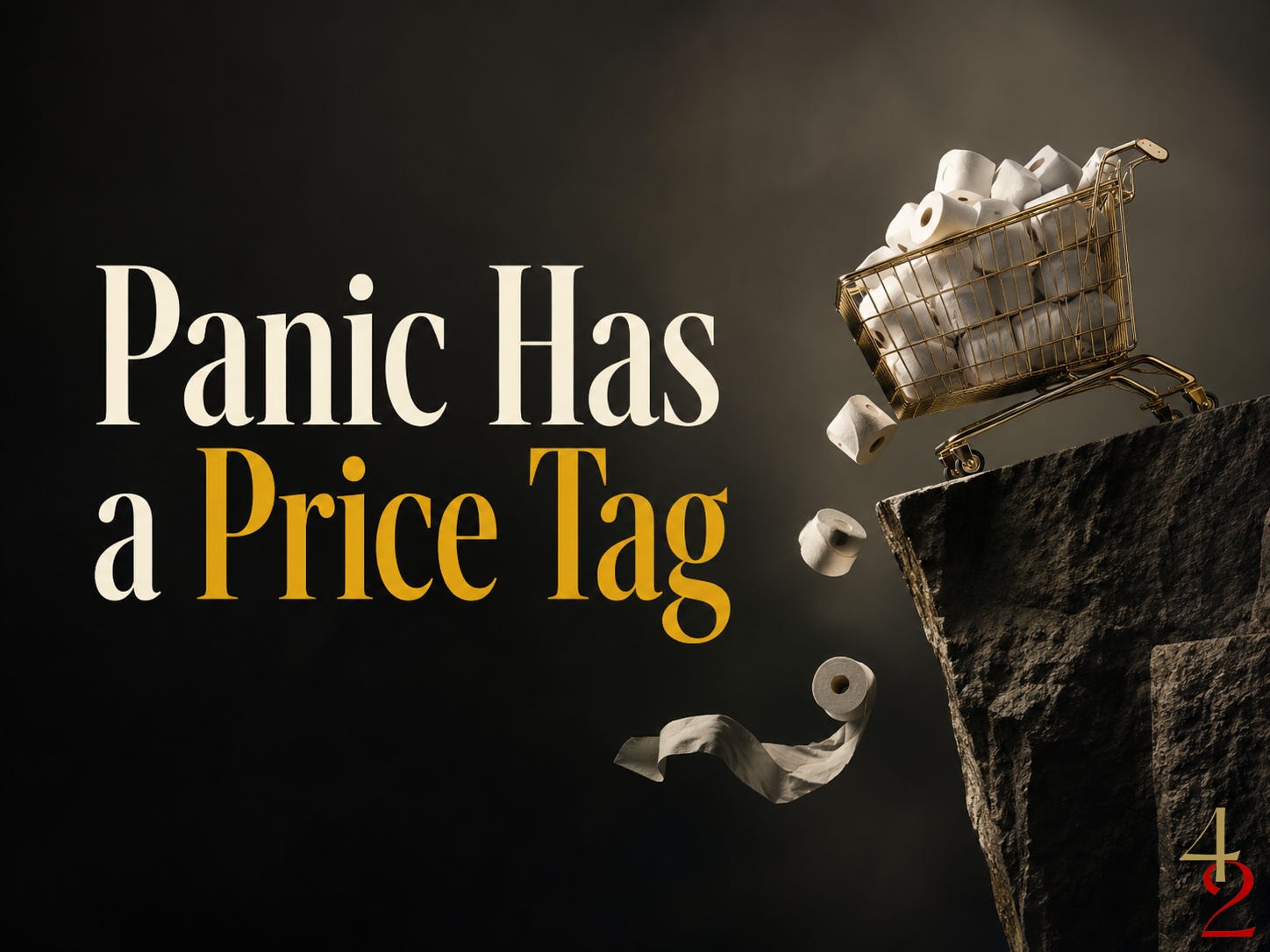
In the first weeks of the 2020 lockdowns, the shelves emptied of toilet paper. Not because the world stopped making it — according to the NC State College of Natural Resources, more than 99% of the tissue products Americans use are manufactured domestically, and the factories never stopped running — but because enough people believed a shortage was coming that their belief produced one. There was no supply problem. There was a demand panic. As NC State’s Ronalds Gonzalez put it during a later repeat of the same scare, the empty shelves were due strictly to panic-buying. The scarcity was manufactured by the fear of scarcity, and it was entirely self-inflicted.
I have been watching the same machinery run again, except this time the empty shelf is your career, and the thing being hoarded is a certificate. Open any feed, and the message is identical in structure to a run on a supermarket: the window is closing, everyone else is already moving, act now or be left behind. Learn fifteen AI tools in a day. Become AI-ready before it is too late. The register is urgency; the product is fear; and, as in 2020, the shortage is not real.
99%+
of the tissue products Americans use are made domestically. The 2020 shortage was demand-side panic, not a supply gap.
NC State College of Natural Resources, port-strike supply comments, October 2024
The panic is the product
Panic buying has a well-documented psychology, and it does not require a genuine shortage to work — it requires only the perception of one. Behavioural researchers traced the toilet-paper episode to perceived scarcity, amplified by social proof: I see others acting, so I act, and my acting becomes the proof that prompts the next person to act. As the economists Sushil Bikhchandani, David Hirshleifer and Ivo Welch argued in their 1992 theory of informational cascades, there is a point at which people rationally copy the crowd without regard to their own information — which is exactly what makes mass behaviour both powerful and fragile. Robert Cialdini catalogued the underlying lever decades ago as the scarcity principle: we assign value to whatever we are told is running out. Add the simple fear of missing out, and you have the complete engine.
The AI-readiness market runs on that engine, part for part, and that fear is the raw material it sells to. The fear is real — according to the 2025 KPMG American Worker Survey, released in November, 52% of US workers now fear being displaced by AI, nearly double the share a year earlier. The urgency is manufactured — there is no cohort cap, no closing window, no moment after which you are permanently locked out of a chatbot. And the social proof is engineered — the entire pitch is that everyone is already reskilling, so you must too. The genius of the model is that it sells the cure for a condition it also produces: it amplifies the panic, then charges you to relieve it.
There is no window closing. That is the entire product.
52%
of US workers now fear being displaced by AI — nearly double the share a year earlier. That fear is the raw material the readiness market sells to.
KPMG, 2025 American Worker Survey, 24 November 2025
Tool tourism
Here is the category error at the centre of it all. The market sells readiness as a checklist of named products — a badge for ChatGPT, a badge for Claude, a badge for Midjourney, a badge for DALL-E — collected at a pace of fifteen minutes a day. I have come to think of this as tool tourism: visiting a great many tools briefly, photographing each, and mistaking the itinerary for fluency. You return with a passport full of stamps and no ability to actually live anywhere.
Coursiv is the mainstream, legitimate face of this. It is not a scam — it is a real company with a real app and hundreds of thousands of users, and for an absolute beginner, a structured, daily nudge has value. But note what its own reviewers say. Consumer-review sites, including Trustpilot commentaries and independent reviews at Techraisal and Coffee Loving Card Makers, observe that the platform can create a false sense of AI proficiency, and that it oversells “AI mastery” while only scratching the surface — confidence with guided exercises that does not survive contact with an unscripted real-world task. That gap, between a completed streak and an open-ended problem, is the whole of the illusion. The certificate certifies that you visited. It does not certify that you can build.
And tool-specific knowledge is the fastest-decaying asset in the entire field. We already have the case study. Two years ago, “prompt engineer” was heralded as the defining new career; according to Indeed data reported by the Wall Street Journal, searches for the title rose from about two per million in January 2023 to 144 per million by April, then collapsed back to the twenties as models grew resilient to phrasing and the skill dissolved into ordinary roles. The people who had bet their careers on the tool were left holding a badge for a checkpoint that no longer exists.
2 → 144 → ~25
searches per million for “prompt engineer” on Indeed — the rise and collapse of a “hot skill” in about two years. Tool-specific expertise decays fastest of all.
Indeed data, reported by the Wall Street Journal, 2026
No one was ever hired as a “Google Search Specialist.” — Rick Battle, staff ML engineer at VMware
The price tag, from the merely oversold to the outright fraud
Tool tourism is the legitimate end of a spectrum, and the same illusion — that purchased breadth equals professional safety — gets monetised all the way along it, with the deception intensifying as the price rises. At the mild end sit the pricing patterns: a course advertised at a few dollars a week that quietly auto-renews at around forty dollars a month once the promotional window lapses, a documented complaint across review platforms. Further along, the claims turn actionable.
Regulators have started arriving. In the United States, as part of its 2024 “Operation AI Comply” sweep, the Federal Trade Commission charged the promoters of an “AI-powered Ecommerce Empire” scheme — training programmes costing nearly two thousand dollars and “done-for-you” storefronts costing as much as thirty-five thousand — with defrauding buyers on false promises of some ten thousand dollars a month in profits that never materialised. In India, according to reporting on an Advertising Standards Council of India warning, regulators flagged misleading AI-course marketing and a bait-and-upsell pattern in which a nominal fee escalates into charges of many thousands. Investigators cataloguing the market — among them the prompt marketplace AIPRM — describe the recurring tells: unaccredited “official” certificates, courses assembled from scraped or AI-generated free material, job-placement “guarantees” with no employers behind them, and the perennial promise of six figures with no coding required. Some operators duplicate certificate identification numbers across dozens of paying students; others post fake “AI trainer” jobs whose unpaid “qualification tests” exist only to harvest free labour and data.
$2,000–$35,000
The price band of the “AI-powered Ecommerce Empire” scheme, which the FTC charged as fraud, was sold on false promises of $10,000 a month. At the fraudulent end, the same readiness illusion simply carries more zeros.
US Federal Trade Commission, Operation AI Comply, September 2024
The scammer and the panicked buyer share a single category error. The buyer believes readiness is something you can purchase in a hurry; the scammer simply agrees loudly and sends an invoice. The fraud is not a different phenomenon from the legitimate over-promise — it is the same illusion with the safety rails removed and a few more zeros on the invoice.
The scammer and the panicked buyer share the same category error. The scammer just monetises it.
What readiness actually is
If a checklist of tools is not a capability, what is? The durable answer is unglamorous and unsellable in fifteen-minute increments. It is the ability to evaluate an AI system’s output rather than merely produce it — to know when the confident answer is wrong. It is a judgement about where a tool belongs in a real workflow and where it does not. It is domain depth, the thing that makes you the person who can tell whether the model’s plausible paragraph is actually true. And it is the capacity to distinguish froth from signal — to tell the manufactured urgency from the genuine shift underneath it.
None of that decays when a tool is renamed, because none of it is about the tool. This is the cruel irony of the readiness market: it sells the perishable and ignores the durable, precisely because the durable cannot be delivered on a daily-unlock schedule with a badge at the end. Real capability is built the boring way — by applying one tool to one real problem for long enough to learn where it fails.
The boardroom runs the same play
It would be comfortable to file all this under consumer protection — a warning for anxious individuals clicking on advertisements. It is not. The same behavioural machinery operates one floor up, in the boardroom, at three or four more zeros. The executive who approves a fear-marketed enterprise “AI transformation” package, procured in a hurry because a competitor announced something and the window is said to be closing, is running the toilet-paper play in a suit. Same manufactured scarcity, same social proof, same purchase of a feeling of safety in place of the harder work of building a capability. Panic buying does not become rational because the invoice is larger.
And here is the part that makes the panic so effective, and so worth resisting deliberately: the underlying shift is real. According to McKinsey, demand for genuine AI fluency grew roughly sevenfold between 2023 and 2025, and jobs are genuinely changing. The shift being real is precisely why the fake cure sells: the panic borrows its credibility from a genuine transformation. The fear has a true kernel, which is exactly why the manufactured urgency lands. The correct response to a real shift is not a panicked purchase of readiness. It is the patient accumulation of durable skills that the panic is too loud to let you hear.
7×
growth in demand for genuine AI fluency between 2023 and 2025 — the real shift the fake cure sells against, and the credibility the panic borrows.
McKinsey & Company, 2025
Do not buy the window
The panic is loudest exactly where the substance is thinnest — in the badges, the fifteen-tool sprints, the closing-window countdowns — and quietest where the substance is greatest, in the slow work of judgement and domain depth that no one can sell you by Friday. That inversion is the whole tell. When something in this market is shouting about urgency, it is usually because it has nothing durable to offer, and the urgency is all it has.
There is no window closing. There never was. The shelves are full. The only real question is whether you will spend the next year collecting stamps in a passport or learning to actually live somewhere — and the people selling you the stamps are counting on you being too frightened to tell the difference.
References
This piece draws on behavioural science literature, public regulatory records, and industry and consumer reports, including material from the US Federal Trade Commission, KPMG, McKinsey & Company, Indeed (as reported in the Wall Street Journal), and NC State University. The prompt-engineering search figures are Indeed’s data as reported by the Wall Street Journal. Coursiv is a legitimate platform; the criticisms cited reflect published user reviews and independent analyses of over-promising, not a finding of wrongdoing.
Bikhchandani, Sushil, David Hirshleifer, and Ivo Welch. “A Theory of Fads, Fashion, Custom, and Cultural Change as Informational Cascades.” Journal of Political Economy 100, no. 5 (1992).
Cialdini, Robert B. Influence: The Psychology of Persuasion. New York: Harper Business, 1984.
Entrepreneur. “AI Is Taking Over for Prompt Engineers.” January 30, 2026. (Indeed search data — 2 → 144 → 20–30 per million — reported via the Wall Street Journal.)
Federal Trade Commission. “FTC Announces Crackdown on Deceptive AI Claims and Schemes.” News release (Operation AI Comply), September 25, 2024.
Federal Trade Commission. “FTC Action Ends Ecommerce Empire Builders Online Business Opportunity Scam.” News release, May 8, 2025.
KPMG. “The American Worker in the Age of AI.” 2025 KPMG American Worker Survey, November 24, 2025.
McKinsey & Company. “Agents, Robots, and Us.” 2025. (Sevenfold growth in AI-fluency demand, 2023–2025.)
NC State College of Natural Resources. Port-strike toilet-paper supply comments (R. Gonzalez). Media statements, October 3, 2024.
VKTR. “The Truth About Prompt Engineering Jobs.” February 18, 2026. (Rick Battle, VMware, on the “Google Search Specialist” that never existed.)
Coursiv. User reviews and independent analyses. Trustpilot; Techraisal; Coffee Loving Card Makers, 2025–2026.
Storyboard18. “ASCI Warns Against Misleading AI-Course Claims.” 2025. (Advertising Standards Council of India.)
AIPRM. “AI-Course Red Flags and How to Spot Them.” 2025.